
Duty of Care at Scale: How a Tier 1 University Secured Its Critical Communications
When we think about cellular coverage on a university campus, the mind usually jumps to students streaming lectures or staff checking emails. But for a modern, multi-campus institution, connectivity is far more than a convenience. It is the communications fabric that underpins an extensive, safety-critical infrastructure.
We recently partnered with a leading Tier 1 North American research university to solve a massive engineering and operational challenge: ensuring continuous, verifiable coverage across more than 700 buildings.
This is the story of how they moved from assumptions to engineering-grade visibility, fundamentally changing how they manage their duty of care.
The Challenge: When Connectivity is a Safety Issue
The university operates a multi-tenanted Distributed Antenna System (DAS) serving tens of thousands of people across multiple campuses. This network supports a vast array of IoT infrastructure, including emergency call boxes, CCTV cameras, building control systems, and monitoring systems for energy, water, and waste.
Equally critical is the P25 public safety radio network. Campus police and emergency services rely on this network for mission-critical voice communications. Coverage inside lecture halls, deep basements, sprawling stadiums, and complex research facilities must be assured at all times.
In this environment, a gap in P25 or cellular coverage during an emergency is not an IT inconvenience. It is a safety failure.
Yet, despite the critical nature of these networks, the university faced a common industry problem: they were flying blind. Without continuous visibility into both cellular and P25 availability and service quality, they had no way to verify that these safety-critical systems were reliably connected. They could not identify degradation before it affected operations, and they lacked the objective evidence needed to hold DAS service providers accountable when issues arose.
The Solution: Continuous Visibility with KALLO
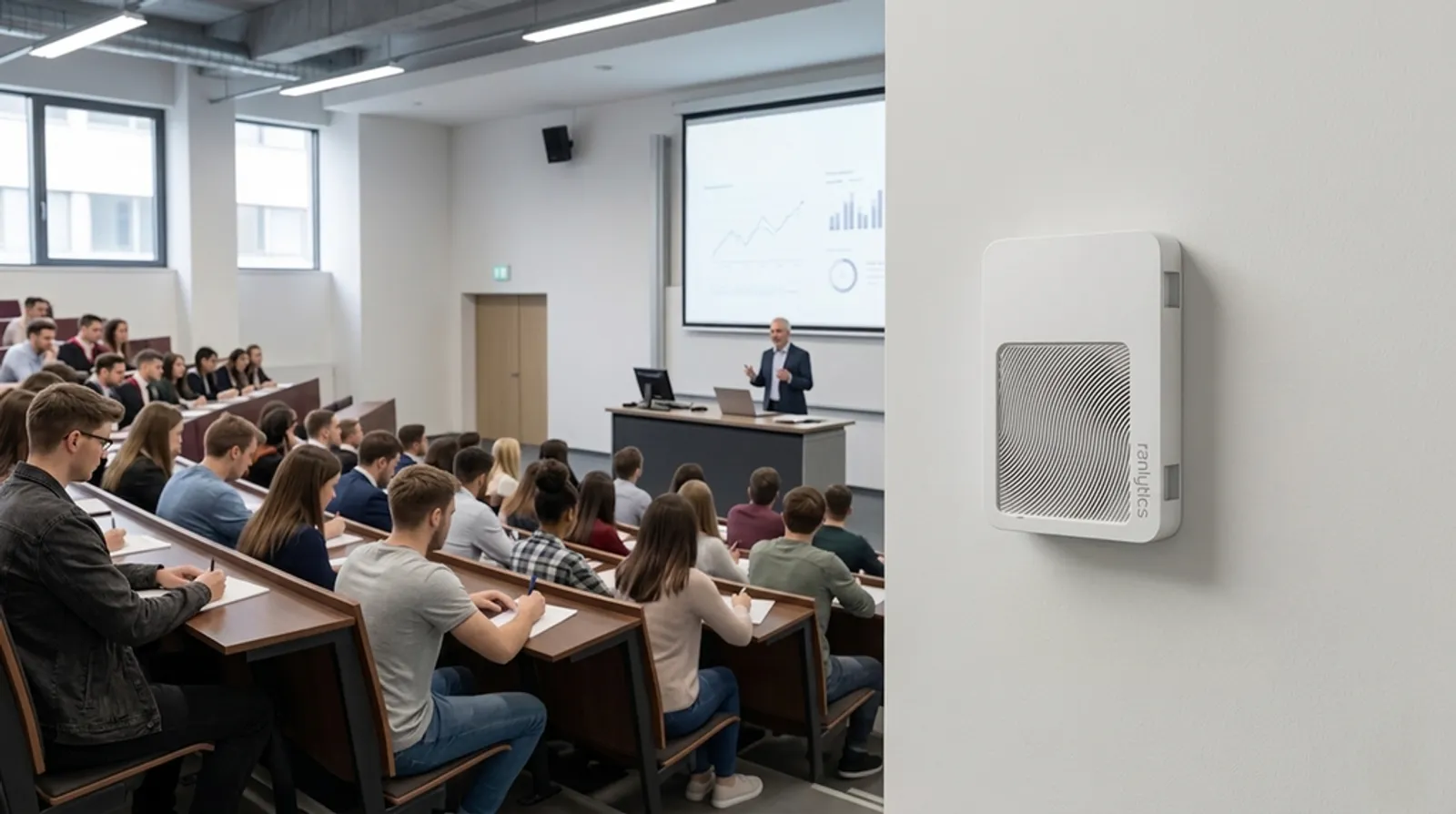
To address this, the university is deploying KALLO monitors into every building on every campus. Where coverage complexity demands it—such as in stadiums or underground utility corridors—multiple units are deployed per building.
Each KALLO device continuously monitors the availability and quality of service delivered by all three US cellular carriers on the DAS, plus the P25 public safety radio network, around the clock.
This is not a point-in-time walk test. It is continuous, real-time intelligence.
Automated alerting notifies the university’s communications team the moment any metric degrades below a set threshold, whether for a commercial carrier or the P25 network. This enables proactive intervention before students, staff, or first responders are ever affected.
Real-World Impact: Detecting the Unseen
The value of this continuous monitoring was proven almost immediately. During the deployment phase, KALLO identified a downed campus antenna. The cause? A fire at the site.
Crucially, KALLO detected this failure through network data before it was reported through any other channel. This is the difference between proactive management and reactive firefighting.
As the university's Communications Systems Specialist noted:
"KALLO gives us something we’ve never had before: 24/7 objective proof that every carrier and P25 network is performing across every building on every campus. For a university of our scale, with the safety-critical IoT infrastructure we operate, that visibility isn’t optional—it’s essential."
What’s Next: Infrastructure, Not Just Evaluation
The university is now expanding the KALLO deployment to achieve complete coverage across every building and outdoor area on every campus.
For an institution with a legal and ethical duty of care to tens of thousands of people, continuous, verifiable coverage assurance is no longer a capability they are merely evaluating. It has become foundational infrastructure.
By replacing assumptions with engineering-grade data, they are ensuring that when their networks are needed most, they will perform.
Get in touch to learn more about how KALLO is transforming network intelligence for critical infrastructure.